Appian: Low-Code Development
Appian Low-Code DevelopmentTutorial for Beginners
Introduction
Appian Low-Code Development is a powerful low-code automation platform that helps organizations build applications, automate workflows, integrate systems, and manage data in a unified environment. By combining low-code development, workflow automation, robotic process automation (RPA), artificial intelligence, and data integration capabilities, Appian allows businesses to accelerate digital transformation and improve operational performance.
This guide explores the Appian platform in detail, covering its architecture, features, automation capabilities, and enterprise use cases.
Appian Low-Code Development Platform
Appian Low-code development has become an essential approach for organizations seeking faster and more efficient application development. The Appian low-code platform enables developers and business users to build applications with minimal manual coding.
Instead of writing thousands of lines of code, developers can design applications using visual interfaces, drag-and-drop components, and configurable workflows. This significantly reduces development time and allows organizations to deploy applications quickly.
Key capabilities of the Appian low-code platform include:
- Visual interface design using drag-and-drop components
- Rapid application development tools
- Prebuilt templates and reusable components
- Seamless integration with enterprise systems
- Automated deployment and updates
Because of these features, Appian allows organizations to deliver enterprise applications faster while maintaining scalability and reliability.
Appian Business Process Management (BPM)
Business Process Management is a core capability of the Appian platform. Organizations use BPM to design, automate, monitor, and optimize business processes across departments.
Appian provides a powerful BPM engine that enables businesses to model workflows using BPMN-based visual process diagrams. These diagrams represent the sequence of activities, decision points, and interactions within a business process.
With Appian BPM, organizations can automate processes such as:
- Loan approvals in banking
- Claims processing in insurance
- Patient onboarding in healthcare
- Compliance workflows in government agencies
By automating these processes, businesses reduce manual work, minimize errors, and improve efficiency.
Appian Workflow Automation Platform
Workflow automation is one of the most valuable capabilities offered by Appian. It enables organizations to automate repetitive tasks and coordinate activities across people, systems, and data sources.
Using Appian’s workflow automation tools, developers can create automated workflows that guide tasks through predefined steps. These workflows can include human tasks, automated system actions, and decision rules.
Some key workflow automation features include:
- Task routing and assignment
- Conditional decision logic
- SLA monitoring and escalation
- Notifications and alerts
- Real-time process tracking
By implementing workflow automation, organizations gain better visibility into operations and ensure that business processes run efficiently.
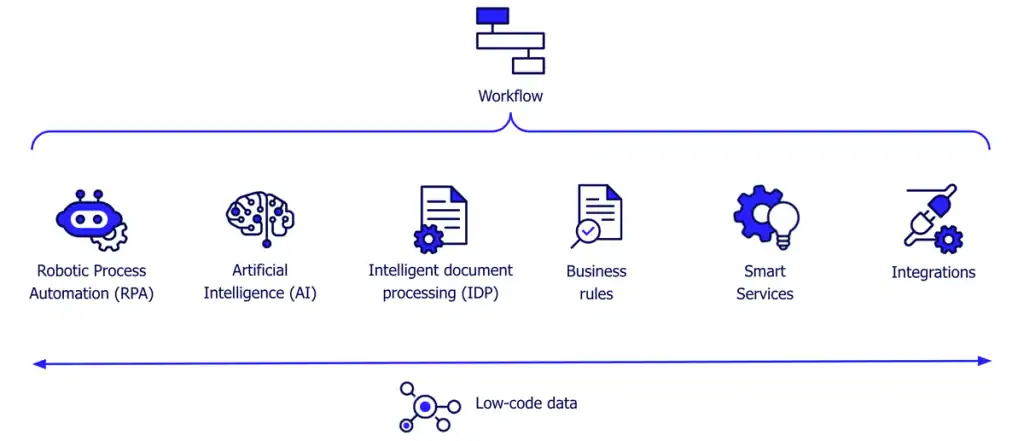
Appian Case Management Solutions
Appian: Low-Code Development. Many enterprise processes are dynamic and require flexible management rather than rigid workflows. This is where case management becomes important.
Appian provides powerful case management capabilities that allow organizations to manage complex cases involving multiple documents, tasks, and stakeholders.
Case management in Appian: Low-Code Development includes features such as:
- Centralized case dashboards
- Document and file management
- Activity tracking and audit trails
- Collaboration tools for the team
- Role-based access control
Industries that benefit from case management include legal services, insurance, government agencies, and customer support operations.
With Appian case management solutions, organizations can track cases from initiation to resolution while maintaining transparency and accountability.
Appian Robotic Process Automation (RPA) Integration
Appian: Low-Code Development. Many organizations still rely on legacy systems that cannot easily integrate with modern applications. Appian addresses this challenge by providing built-in robotic process automation capabilities.
RPA allows software robots to perform repetitive tasks that typically require human interaction with applications.
Examples of RPA tasks include:
- Extracting data from legacy systems
- Automating form submissions
- Copying data between applications
- Performing routine system updates
Appian integrates RPA with its workflow automation capabilities, enabling organizations to achieve end-to-end automation across multiple systems.
Appian Data Fabric Architecture
One of the most innovative features of the Appian platform is its Data Fabric architecture. In many organizations, data is distributed across various systems like databases, customer relationship management (CRM) platforms, and enterprise resource planning (ERP) systems.
Benefits of Appian Data Fabric include:
- Real-time data access
- Reduced data silos
- Simplified data modeling
- Improved data governance
- Faster application performance
This architecture ensures that applications built on Appian always use accurate and up-to-date data.
Appian Process Modeling with BPMN
Process modeling is a fundamental step in business process automation. Appian provides a visual process modeling tool that allows developers to design workflows using BPMN (Business Process Model and Notation).
Appian provides a process design platform that allows developers to create workflow diagrams showing the sequence of tasks, events, plus decision points involved in a business process.
The advantages of process modeling include
- Improved collaboration between business and IT teams
- Easier identification of process bottlenecks
- Faster process optimization
Process modeling helps organizations understand how their operations work and identify opportunities for automation.
Appian Enterprise Application Development
Appian Low-Code Development is widely used for building enterprise-grade applications that support critical business operations.
Developers can use Appian Low-Code Development to create applications for areas such as:
- Customer relationship management
- Supply chain management
- Human resources onboarding
- Procurement systems
- Compliance tracking
Because the platform provides built-in security, integration, and workflow capabilities, developers can focus on designing business logic rather than building infrastructure.
Enterprise applications built on Appian Low-Code Development are used for scalable, secure, and easy-to-maintain.
Appian REST API Integration
Integration with other systems is essential for enterprise applications. Appian provides powerful REST API integration capabilities that allow applications to communicate with external systems.
Using REST APIs, developers can:
- Retrieve data from external systems
- Send information to third-party services.
- Integrate with cloud applications.
- Connect with enterprise databases.
- This integration capability ensures that Appian applications can work seamlessly within the broader enterprise technology ecosystem.
Appian Cloud Deployment Architecture
Appian: Low-Code Development supports flexible deployment options that allow organizations to choose the infrastructure that best suits their needs.
Deployment models include:
- Public cloud
- Private cloud
- Hybrid cloud
- On-premises environments
Cloud deployment offers several advantages, such as scalability, automatic updates, and high availability.
The cloud-native architecture of Appian ensures that applications remain reliable and responsive even as user demand increases.
Appian AI and Intelligent Document Processing
Artificial intelligence is becoming increasingly important in business automation. Appian integrates AI capabilities to enhance automation and decision-making.
One of the most powerful AI features in Appian is Intelligent Document Processing (IDP). This technology automatically extracts data from documents such as invoices, contracts, and forms.
AI features in Appian include:
- Machine learning model integration
- Document data extraction
- Predictive analytics
- Natural language processing
These capabilities allow organizations to automate document-based processes and reduce manual data entry.
Appian Enterprise Automation Platform
Appian is often described as a comprehensive enterprise automation platform. It brings together multiple technologies to automate business operations across the organization.
These technologies include:
- Low-code application development
- Workflow automation
- Business rules engines
- Robotic process automation
- Artificial intelligence
By combining these capabilities in a single platform, Appian enables organizations to achieve end-to-end automation.
Appian Digital Transformation Platform
Digital transformation involves using technology to improve business processes, customer experiences, and operational efficiency.
Appian plays a significant role in digital transformation by helping organizations automate legacy processes and build modern applications.
Companies use Appian to:
- Replace manual processes with automated workflows
- Integrate legacy systems with modern applications.
- Improve data accessibility across departments.
- Deliver better digital services to customers.
These improvements help organizations remain competitive in rapidly changing markets.
Appian Security and Compliance Features
Appian Low-Code Development is Security, and compliance are critical requirement for enterprise software platforms.
Appian provides robust security features to ensure that applications and data remain protected.
Key security capabilities include:
- End-to-end encryption
- Multi-factor authentication
- Role-based access control
- Audit logs for monitoring activity
- Compliance with industry standards
These security features make Appian suitable for highly regulated industries like finance, healthcare, and government.
Appian Platform Architecture and Components
The Appian platform architecture consists of several components that work together to support application development and automation.
Major components include:
- Process engine for workflow execution
- Interface designer for user experience creation
- Data Fabric for unified data access
- Integration services for system connectivity
- Analytics tools for monitoring performance
This modular architecture allows organizations to build scalable applications while maintaining flexibility and control.
Frequently Asked Questions (FAQs) – Appian Low-Code Development
What is Appian?
Appian is a leading low-code automation platform used to build enterprise applications for workflow automation, business process management (BPM), case management, and digital transformation. It enables rapid application development with minimal hand-coding.
What are the prerequisites for learning Appian: Low-Code Development?
There are no strict prerequisites. However, basic knowledge of:
- Programming concepts
- Databases (SQL basics)
- Business process flow
is helpful. Java/.NET developers, business analysts, and fresh graduates can easily learn Appian.
Who should enroll in this Appian: Low-Code Development training?
This course is ideal for:
- Software Developers
- Java/.NET Professionals
- Business Analysts
- BPM Professionals
- Fresh Graduates
- IT Project Managers
Anyone interested in low-code development and workflow automation can join.
What real-time projects are included in the training?
Our training includes hands-on Appian real-time projects, such as:
- Loan Approval Workflow System
- Employee Onboarding Application
- Incident Management System
- Case Management Application
5. Will I get hands-on experience during the course?
Yes. The course includes:
- Live project implementation
- Process modeling exercises
- SAIL interface development
- Database integration practice
- Deployment demonstrations
We focus heavily on practical learning.
6. Does this course cover Appian certification preparation?
Yes. Our Appian certification training includes:
- Associate Developer exam guidance
- Mock tests & practice questions
- Scenario-based exercises
- Interview preparation support
We align the syllabus with certification requirements.
7. How long does it take to complete the Appian training?
Typically, the course duration is:
- 6–8 weeks (weekday batches)
- 8–10 weeks (weekend batches)
Corporate training schedules can be customized
Item #4
Item #5
Item #6
Item #7
Item #8
Item #9
Item #10
Item #11
Item #12
Will I get hands-on experience during the course?
Yes. The course includes:
- Live project implementation
- Process modeling exercises
- SAIL interface development
- Database integration practice
- Deployment demonstrations
We focus heavily on practical learning.
Does this course cover Appian: Low-Code Development certification preparation?
Yes. Our Appian certification training includes:
- Associate Developer exam guidance
- Mock tests & practice questions
- Scenario-based exercises
- Interview preparation support
We align the syllabus with certification requirements.
How long does it take to complete the Appian: Low-Code Development training?
Typically, the course duration is:
- 6–8 weeks (weekday batches)
- 8–10 weeks (weekend batches)
Corporate training schedules can be customized.
What career opportunities are available after completing Appian: Low-Code Development training?
After completing the course, you can apply for roles like:
- Appian Developer
- Appian BPM Consultant
- Appian Business Analyst
- Appian Technical Lead
- Low-Code Automation Engineer
Demand for Appian professionals is growing across industries.
What salary can I expect as an Appian: Low-Code Developer?
The salary depends on experience, location, and certification level. Certified Appian developers typically earn competitive salaries compared to other low-code platforms due to high market demand.
Do you provide placement assistance for Appian: Low-Code Development?
Yes, we provide:
- Resume building support
- Mock interviews
- Interview question preparation
- Job referrals (based on availability)
Our goal is to help you secure Appian developer jobs successfully.